We didn't see much of Jakarta, but we met a lot of Baha'is including two counsellors from Malaysia. One is also the counsellor for Cambodia, and it was pretty incredible to hear about the huge numbers of people becoming Baha'is in a formerly non-religious country. It's such a global religion, in form and function, and it's great to see. In Jakarta we visited a home where over 30 children and jr. youth from a nearby village were singing songs about world unity and learning about how to eliminate prejudice.
Back in Surabaya, we plunged into the planning of a special 'open house' for the parents of the students in the virtues class we've been involved with. Four mothers came. We began by telling them about the Baha'i principle that all religions come from the same God (whatever the name) and thus there were many ways to pray. After prayers, we talked about the necessity for moral education - if school can make you into a doctor, what will make you into a good doctor? If school can make you into a policeman, what will make you an honest police man, free of corruption (a big issue here)? Immediately, the mothers began grinning, and saying that since they spent all their time in the market, that their children were lacking in this aspect and they were so happy to have sent their children. Their first response was to thank the teachers profusely. One of the mothers who had been sending her children (model students), had been previously concerned that there wasn't any writing and learning going on. When she learned about the activities, she asked if she could bring her neighbor's children. The activities include crafts, drama, songs, science and so forth to illustrate virtues like generosity, truthfulness, perseverance and cleanliness. In short, the response was so good that the man living in the house forgot all about his fears of having too many children coming to his home for the classes - in fact, he hadn't wanted to have the classes at all less than a year ago. It was wonderful, especially since so many Indonesian adults are so reluctant to make any changes in their lives, constantly living in a world of fear - only recently were people free to study what they wanted and belong to the organizations that they wanted. In fact, even now there is a complex social structure that involves neighborhood heads. Within the city, each block has a man who is in charge of the goings on in that area. The people must inform him of all events, pay dues, and go to him for their id cards. If he doesn't like the people coming to your house, you are endanger of being visited by a corrupt policeman or two looking for bribes at the least. This is the law as it was set up during Dutch rule and this is how it continues, keeping everyone in a constant state of fear of their neighbors. When we decided to have children's classes at this house, the resident was mostly afraid of what the neighbors would say. Now that the neighboring mothers had such a positive response, he's overcome a little of that fear, and it feels like a tremendous weight has been lifted.
In other news, we will be returning to America next July. We had thought of staying a third year -because it will be hard to leave the community we've gotten to know and because it means saving a good deal of money - but Greg was informed that he in fact did not have the option of returning. It's not a good boss, or a good job, so it's a good thing, though the feeling is quite negative. Greg certainly wasn't informed of this loss of option in a very professional manner and no event lead up to it - absolutely no words of either praise or punishment have been bestowed upon him from the higher powers this year. Which is too bad, since he had at least one student score a 5 on the AP exam last year and this year is teaching overtime without the pay so that more students can fit the AP class into their schedules.
So until we return, we have a lot of places to travel to! We won't get to them all, and it's always a tough call if we should spend time with friends on the weekends or abandom them to travel on our own. The mud keeps us from any weekend destinations for the time being, but we're going to do some diving in Bunaken National Park in North Sulawesi over the winter break. (Winter - hah!) From there, we're going to a Baha'i youth conference outside of Jakarta, then up to Sumatra since Greg hasn't been. Later we're hoping to get to Cambodia and maybe Thailand and maybe even Vietnam, then hopefully India before we go to Haifa, Israel for Baha'i pilgrimage with my parents and brother. So much to see and so little time! We'll have to scrap both the plans to return via Europe and the trans-siberian railway and also Island hopping through Papua, New Zealand, Samoa and Hawaii towards California. And there are still all those islands and cultures in Indonesia!
Wednesday, December 6, 2006


Wednesday, November 15, 2006
My birthday weekend we tried to drive to the beach, but we didn’t realize the mud had overflowed the dam again. The toll road was closed and of course there weren’t any signs or people helping to divert the traffic. There were some random people waving their arms so we followed them – turned out it was just the locals coercing people to drive through their village. This gave them the opportunity to set up a road block outside the mosque with some boys with buckets asking for money. We found our way back to the road which would allow us to turn around and spent 5 hours sitting in traffic to go the total distance of 4 kilometers. The sunset was beautiful over
I watched TV all day Saturday, which was an experience. There were very tragic soap operas and lots of footage on Bush’s eminent arrival in
My birthday weekend we tried to drive to the beach, but we didn’t realize the mud had overflowed the dam again. The toll road was closed and of course there weren’t any signs or people helping to divert the traffic. There were some random people waving their arms so we followed them – turned out it was just the locals coercing people to drive through their village. This gave them the opportunity to set up a road block outside the mosque with some boys with buckets asking for money. We found our way back to the road which would allow us to turn around and spent 5 hours sitting in traffic to go the total distance of 4 kilometers. The sunset was beautiful over
I watched TV all day Saturday, which was an experience. There were very tragic soap operas and lots of footage on Bush’s eminent arrival in
Sunday, October 29, 2006
Flores
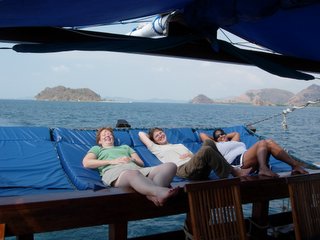 Last week was the Idul Fitri holiday (the end of Ramadan, the Muslim month of fasting). I had the idea of going to the islands of Flores and Komodo, so when I heard that two teachers were already planning a trip we joined rather than create our own. They were going through a tour company, which I’d never done, but it seemed so much easier that we went along with it.
 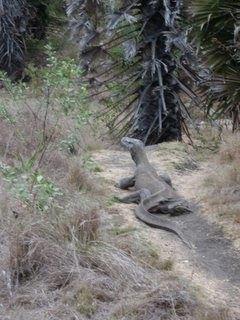 between. We landed on the West coast of
 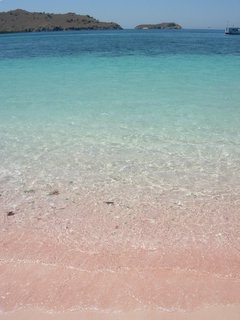 t was dark when we returned to the boat to play cards. We got up the next morning at sunrise and took another hike on Komodo island. There weren’t many dragons at all, but we did see lots of deer, wild boar, and some very cool birds. It was very hot but surprisingly fall-like with leaves crunching under our feet. Strange, since it’s currently supposed to be spring in the southern hemisphere. After our hike we cooled off in the ocean off the pink beach. The sand was an even mix of red and white grains with not a speck of trash, the water was tourquoise, and the current was cold so we saw a lot snorkeling. It was incredible. We could have stayed all week. Unfortunately, we only got to stay for a short time. We were off to a second beach on another island – there were hundreds of islands all around at all times. This beach was definitely not as nice. The snorkeling was good – I saw a huge eel with brown spots, but the current was very fast and the beach was dirty (Greg saw a hyperdermic needle. Ugh.) Back at the boat we (especially Greg) jumped off into the water until sunset, when we went back to the beach for a terrific tuna barbeque. On the way we watched thousands of fruit bats leave the mangrove island we were anchored next to. On the way back, the little motor boat lit up the phosphorescence in the water and it was totally amazing. The third day we woke up and immediately hoped in the water to snorkel towards the beach. It was amazing, and the beach was also beautiful (though not pink). I thought I’d found some sort of exotic species of nudibranch or something but they turned out to be blue-lipped clams hiding in the rocks. The fish were amazing and it would have been great to be on the other of the tour’s boats, the live-aboard diving boat, Felicia, which I’m sure cost a s
 mall fortune to stay on.
 ckly pressed on to lunch at 4:30. Poor planning on the part of whoever designed our itinterary. The guide answered Greg’s question about the stones by explaining that the water made them blue. A likely story. We had a good lunner? of Chinese sweet-and-sour fried fish and squid and finished with ice cream since we were waiting for the driver to return with lug nuts for the car. At around 8 we thought we were stopping for directions at a church, but found out we were staying with the Franciscan nuns (most of
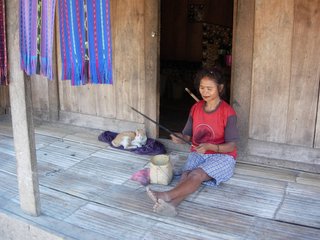
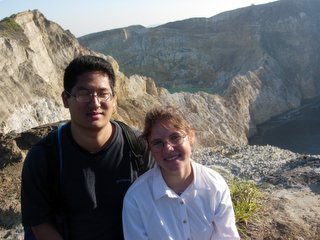 king on a door and assumed that was our guys. He spent the next 5 minutes or so banging on the door and yelling. Finally the driver emerged and without apology asked if we were all awake. We finally left close to 4 and had a very scary, fast drive around the side of the volcano in the dark as the driver tried to beat the sunrise. We were pretty surprised that there was a long hike up to the crater – though I suppose that’s obvious – so we hiked as fast as we could, only just missing the sunrise. It would have been too dark to see much, but it was a major bummer. We hung out at the lakes for a few hours. One lake was milky turquoise, the others were coca-cola colored. I guess the souls of the young go to one lake, the old to another, and the bad souls go to the third. That’s according to the sign. I met an old man selling tea and had a wonderful discussion about religion in Indonesian. I didn’t get much more insight on the lakes, but he did tell me that some scientists were able to take samples from the lakes every few months. It sounds like they change every 20-50 years due to dissolved mineral content from rainwater runoff and erosion. 50 years ago they were red, yellow, and blue. We finally left, stopping to eat the moldy bread and cheese the nunnery had packed us, then drove to a village which was preparing for a ceremonial feast later in the day. Of course we couldn’t stay, but the woman in the chief position took us into the ceremonial house and told us all sorts of things. It turned out that I was a better translator than our guide, and she said the lakes represent the spiritual progress of the people – they changed color when the villages became Christian and started wearing more ‘decent’ clothing. We bought several naturally-dyed ikat cloths from her – one a modern design which had the lakes in it, one a traditional tube sarong that has multiple uses, and a third with a traditional design that looks like flowers dyed mostly with mango bark and beetle nut. She gave us a pomelo for the road, we stopped at a beautiful beach for lunch (they were out of fish), then stopped at one more village which was preparing for a procession for St. Mary. It happened to be the same day as Idul Fitri, and the whole village was full of what looked like flower girls. We took a picture with some of the nuns, waved off the pushy cloth sellers, and went on to our last hotel, a dingy place by the north coast near the airport. The next morning we walked through the market and a fishing village, then flew back to
The great thing was that the whole time, people kept asking where we were from. With Greg and Clea in our group, we had lots of opportunities to explain about the diversity in 
Saturday, September 30, 2006
Sumatra
 And a lot did happen. I went with my American friend and her two children to her amazingly beautiful house in Sanur,
  her husband from
  hange, I taught several children, theirs included, how to sing “head, shoulders, knees and toes” and then explained (in Indonesian, which they understood even with my limited language ability) about how many people in the world don’t like other people because they have different noses or eyes or knees or skin color, but that Baha’u’llah – the founder of the Baha’i Faith – teaches that these differences should not be a problem. That our hearts are all the same and that we should all be like one family. Outside was a beautiful flower garden full of pink and yellow crysanthemums. People in Java don’t only have flower gardens if they are wealthy enough to pay someone to garden for them.
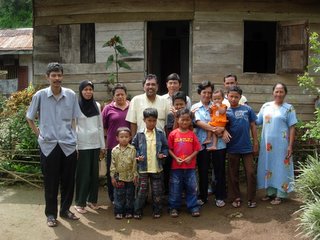
At the end of the week I spent the weekend in Padang (Padang is where the ferry leaves to the Mentawai islands which takes about 10 hours – of note to anyone who has read Dr. Muhajir). The first day I went with a girl to visit her Buddhist friend. Then we went to the family noodle factory. It was an experience. There were trays of what looked like screen doors with piles of bright yellow noodles drying in the sun. There were teenagers packing the noodles into bags outside under a covered area (no gloves, no hairnets, dirt floor), and inside were the mixing vats, nasty-looking steaming water, and piles of broken waste noodles. I turned down the offer to try some. We hurried to meet with some youth in the community and returned that evening to talk to the many visitors who had come to the house I was staying in. The next day we visited a Baha’is grave on a hill overlooking the sea and facing the Mentawai islands – really beautiful, then drove out to the beach. We visited a very old woman whose door opened onto the ocean. Her husband had made beautiful cross-stitch tapestries of scenes such as the Baha’i Holy site of Bahji. She fed us fried sweet potatoes and we proceeded to a tourist area on the beach with a legend about a man who left from that place to seek a fortune and forgot his mother, after which his ship sank and he was turned into stone on that very spot. It was a difficult drive with several children – seatbelts and carseats especially are unheard of – and I was glad to be going home the next day. Until the airline called and cheerfully told me that my flight had been cancelled. To make a long story short, I made it home in time to teach my Monday afternoon flute student, so it was just fine in the end.
Sunday, September 10, 2006
Bojonegoro
Last weekend was pretty amazing. There was a Baha’i conference at the Soraya home in Bojonegoro. Our young friend Hanafi left his motorbike at our house and we took the taxi for an hour to the bus station which is in an area with what I believe are salt-drying fields. We waited at the bus station for an hour before some friends arrived, then we got on the bus. After about 2 ½ hours we arrived and piled into beceks. We drove through the dark streets lit by star-shaped lanterns in the colors of the Indonesian flag. For once we weren’t the only foreign guests – a German woman pioneering in Sumatra was there, in addition to several of the Soraya relatives including the counselor, George, his wife, and their niece from
We left the conference full of wonderful, sweet mangos (totally unlike the fibrous ones in
Subscribe to:
Posts (Atom)
